The board
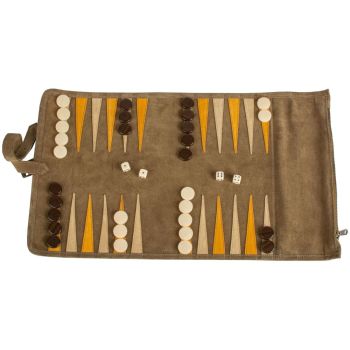
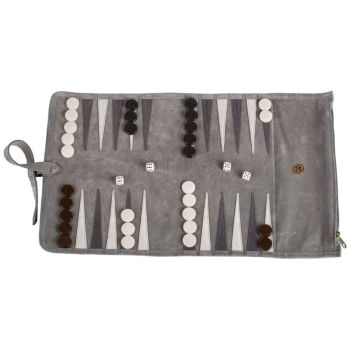
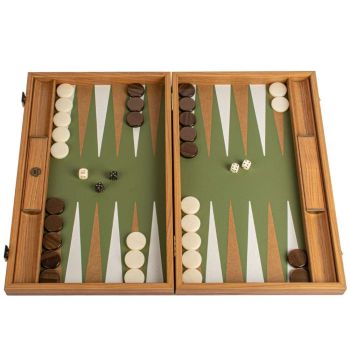
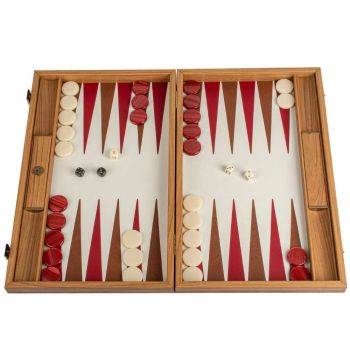
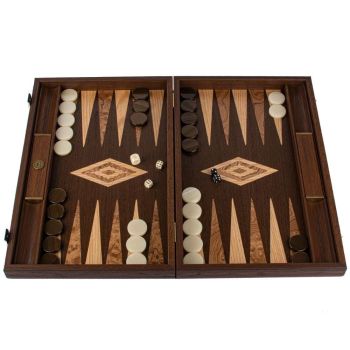
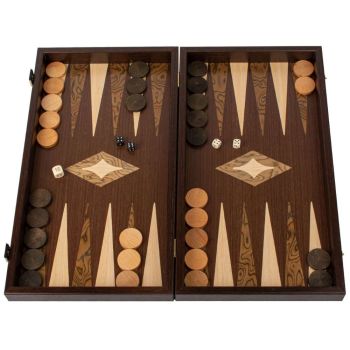
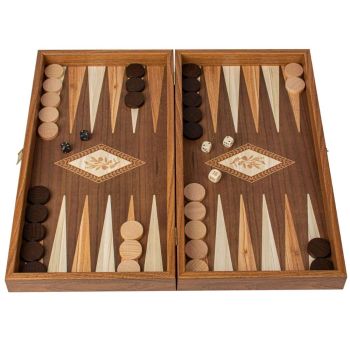
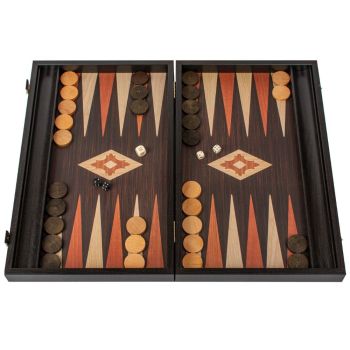
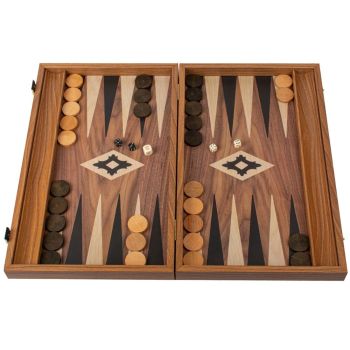
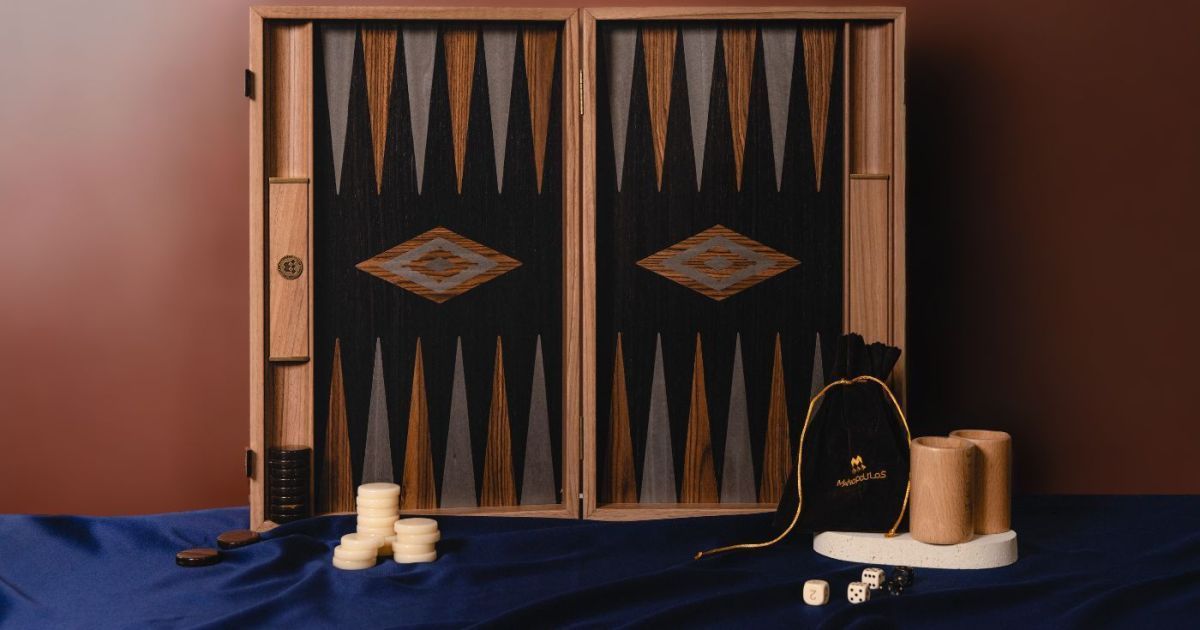
The playing surface is made up of 24 narrow triangles called points, split into four quadrants of six. A ridge down the centre, the bar, divides the board into two halves. Each player has a home board (the quadrant they are working towards) and an outer board. Points can hold any number of checkers of the same colour.
The checkers
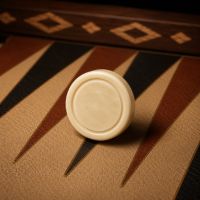
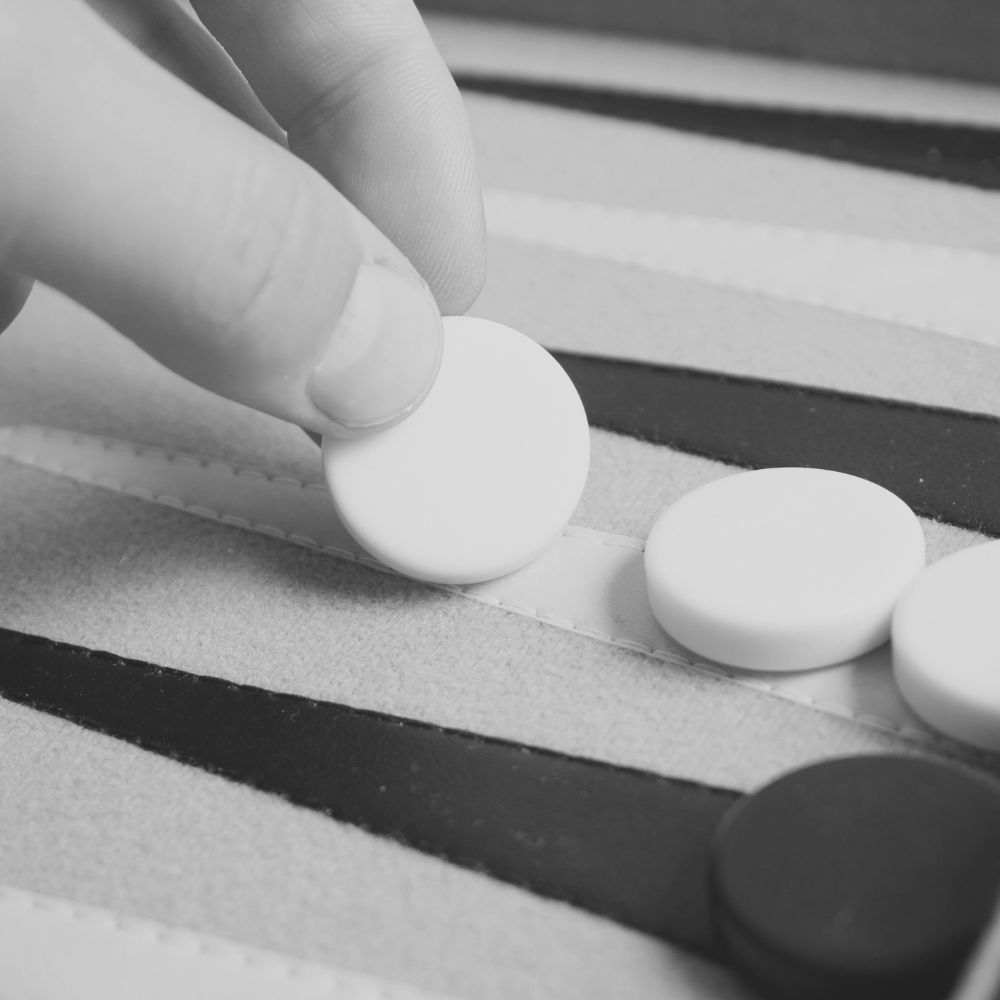
Each player starts with fifteen. The two sides travel around the board in opposite directions, so your progress and your opponent's run head-on against each other. Checkers serve double duty throughout: advancing towards home, blocking your opponent's path, and covering one another from attack.
The dice.
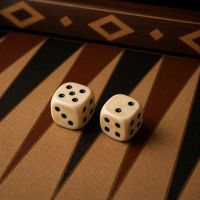
Each turn is governed by two six-sided dice, which tell you how far your checkers may move.
The doubling cube.
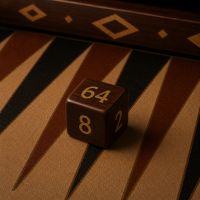
A larger die marked 2, 4, 8, 16, 32 and 64. It plays no part in movement; it is used to raise the stakes during match play, and we cover it below.
Setting Up the Board
Before anything else, the checkers must be placed in their starting position. Picture the points on your side numbered 1 to 24, counting from your home board outwards. Each player sets up a mirror image of the other. Your fifteen checkers begin like this:
- Two checkers on your 24-point — the farthest corner, deep inside your opponent's home board.
- Five checkers on your 13-point — the midpoint, in your outer board.
- Three checkers on your 8-point.
- Five checkers on your 6-point — inside your own home board.
That accounts for all fifteen. Your opponent's checkers sit in the exact mirror positions, facing the other way.
The Object of the Game
Your goal is to move all fifteen of your checkers around the board and into your own home board — the six points nearest you — and then to bear them off, removing them from play entirely. The first player to bear off all fifteen checkers wins the game. Because the two sides move in opposite directions, you are racing your opponent while also trying to slow them down.
Taking a Turn
To decide who starts, each player rolls a single die; the higher number goes first and plays the two dice already showing. From then on, players alternate, rolling both dice at the start of every turn.
Moving your checkers. The two dice give you two separate moves. If you roll a 3 and a 5, you may move one checker three points and another checker five points, or move a single checker eight points in total — provided it can legally pause on an intermediate point along the way. You must use both numbers if a legal move exists for each; if only one can be played, you play that one and forfeit the other.
Rolling doubles. Roll the same number on both dice and you play that number four times, not two. A roll of double 4s, for example, gives you four moves of four points each — a powerful and sometimes game-changing turn.
Where you can land. A checker may land on any point that is open, occupied by your own checkers, or holding just a single enemy checker. A point held by two or more of your opponent's checkers is blocked, and you cannot land there.
Hitting, Blots and the Bar
A lone checker sitting on a point is called a blot, and it is vulnerable. If your opponent lands on your blot, the checker is hit: it is removed from the point and placed on the bar in the centre of the board.
A checker on the bar must re-enter the game before its owner may make any other move. You re-enter by rolling the dice and placing the checker on the matching point within your opponent's home board — a roll of 4 enters on their 4-point, and so on. If both of those entry points are blocked, you cannot enter at all and must forfeit your turn until a route opens. A single well-timed hit can therefore stall an opponent's entire game, which is what makes attacking such a potent — if risky — weapon.
Bearing Off
Once all fifteen of your checkers have reached your home board, you may begin bearing off — removing them from the board according to your rolls. A 6 bears off a checker from your 6-point, a 3 from your 3-point, and so on. If you roll a number higher than your highest occupied point, you may bear off a checker from the next-highest point instead, so no roll is ever wasted.
One caution: if one of your checkers is hit and sent to the bar while you are bearing off, you must bring it all the way round and back into your home board before you can resume. The first player to bear off all fifteen checkers wins.
How to Win: Single, Gammon and Backgammon
Not every victory is worth the same. There are three outcomes, in ascending order of glory:
- A single game is worth one point, and occurs when the loser has already borne off at least one of their own checkers.
- A gammon is worth two points. It happens when you bear off all your checkers before your opponent has borne off a single one.
- A backgammon, the most decisive win of all, is worth three points. It occurs when your opponent has borne off none of their checkers and still has a checker on the bar or stranded inside your home board.
This scoring adds a second layer of ambition: sometimes the aim is not merely to win, but to press your advantage into a gammon or backgammon.
The Doubling Cube
The doubling cube turns backgammon into a game of nerve. At any point before rolling, a player who feels they hold the advantage may offer to double the stakes, turning the cube to 2. Their opponent must then choose: accept and play on for the higher stake, taking ownership of the cube and the sole right to double next, or decline and concede the game immediately at its current value.
A well-judged double can win a game outright by forcing a nervous opponent to fold. A reckless one hands your rival the initiative. Reading these moments is one of the great skills of the game.
Strategy for Beginners
The rules can be learned in an evening; the game takes a lifetime to master. A few principles will sharpen your play quickly.
Protect your blots. A lone checker is an invitation. Wherever possible, move your checkers in pairs or into positions where they support one another. Leaving blots scattered across the board can shift the game's momentum in an instant.
Build points and primes. A point held by two or more of your checkers is blocked to your opponent. String several blocked points together and you form a prime — a wall your opponent's checkers cannot cross. Six consecutive points make a full prime, and anything caught behind it is trapped until the wall comes down.
Develop your whole army. Beginners often fixate on racing one checker home. Spreading your development across several checkers builds stronger positions and leaves fewer stragglers exposed.
Attack with judgement. When your opponent leaves a blot, hitting it and sending them to the bar can wreck their plans. But aggression has a cost: overreach and you expose blots of your own to the counterattack.
Play the odds. You cannot command the dice, only prepare for them. Strong players think several rolls ahead, weigh the likely outcomes and position their checkers to make the most of whatever the dice deliver. Backgammon is a game of probabilities, and the better forecaster usually wins.
A Game Worth Owning
Few games have endured like backgammon, and part of its appeal lies beyond the board. A fine set is an object in its own right — leather, wood and suede worked by hand, as pleasing to display in a library or study as it is to play. It is the rare gift that offers craftsmanship, heritage and genuine entertainment in equal measure, and it only grows more characterful with use.
Now that you know how to set up, move, hit and bear off, all that remains is to roll the dice and discover for yourself why backgammon has captivated players for thousands of years.
Explore our collection of luxury backgammon sets and find the board that will be enjoyed for decades to come.